

Knowledge designer
Model knowledge as linked tables of typed properties in local YAML, XML or JSON files, with views that sort, filter and group them.
Designer · origin tag etalii/knowledge · Designers
Availability
| Host | State | How to get it |
|---|---|---|
| Standalone | Prototype | Not yet released |
| Desktop | Prototype | Not yet released |
| IntelliJ Platform | Not planned | Not planned |
| Visual Studio Code (called Knowledge here) | Prototype | Not yet released |
| Eclipse | Not planned | Not planned |
| ThinkRail | Not planned | Not planned |
| Notion | Not planned | Not planned |
| Claude | Not planned | Not planned |
What it is for
A designer that stores row and column based information in YAML, XML or JSON files. Inspired by Notion's database and other similar solutions, it brings the knowledge engineering capability to local systems. Its goal is to assist users with the modelling of knowledge, both for personal use and to facilitate human-tailored LLM knowledge engineering. Properties can quickly be generated and changed: text, numbers, dates and times, times, selections, multiple selections and more. Several such database files can be linked together by defining properties as (multi) directional relations. Each file also contains views, in which property visibility, sorting, filtering and row grouping (by parent, by a select property and so on) can be applied.
Why a specialized view helps
It brings the knowledge engineering of Notion's databases to local files: properties are quickly generated and changed, files are linked through (multi) directional relations, and views keep visibility, sorting, filtering and grouping beside the data, for personal use and for human-tailored LLM knowledge engineering.
File formats
Not described yet.
Screenshots
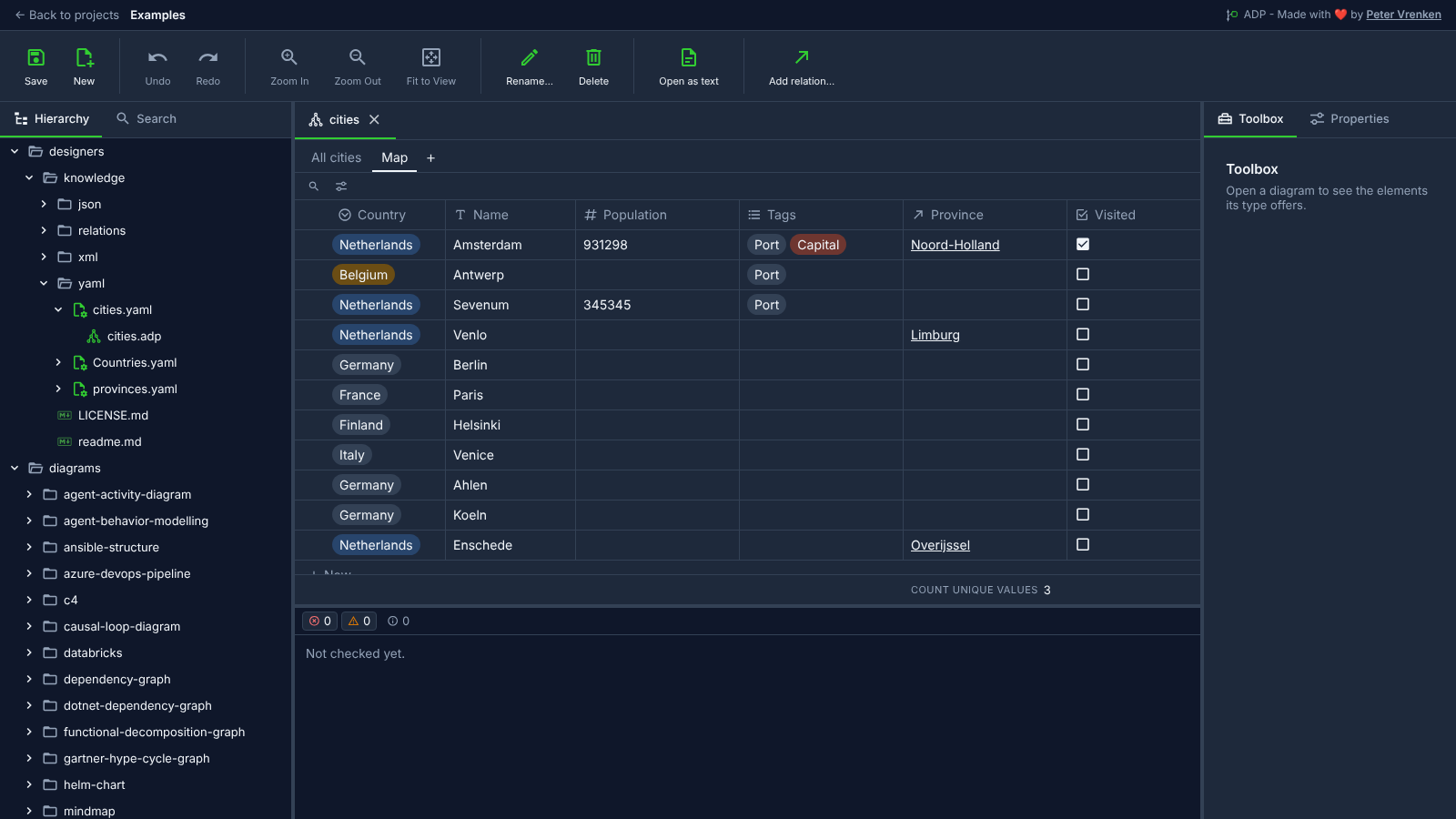
Standalone, at 5ac81b3
What is visible: The knowledge designer's table of cities in its view *Map*: the *All cities* and *Map* view tabs, the columns Country, Name, Population, Tags, Province and Visited with their type icons, selection values as coloured chips, the Province relation as links, and the column summary along the bottom. Not fitted: a table has no canvas. Nothing selected.
Why it matters: A table of cities kept in a plain YAML file opens as a database: typed columns, coloured choices, a relation to the provinces file and views of its own, while every change is written back to the file under version control.
Licence: Apache-2.0
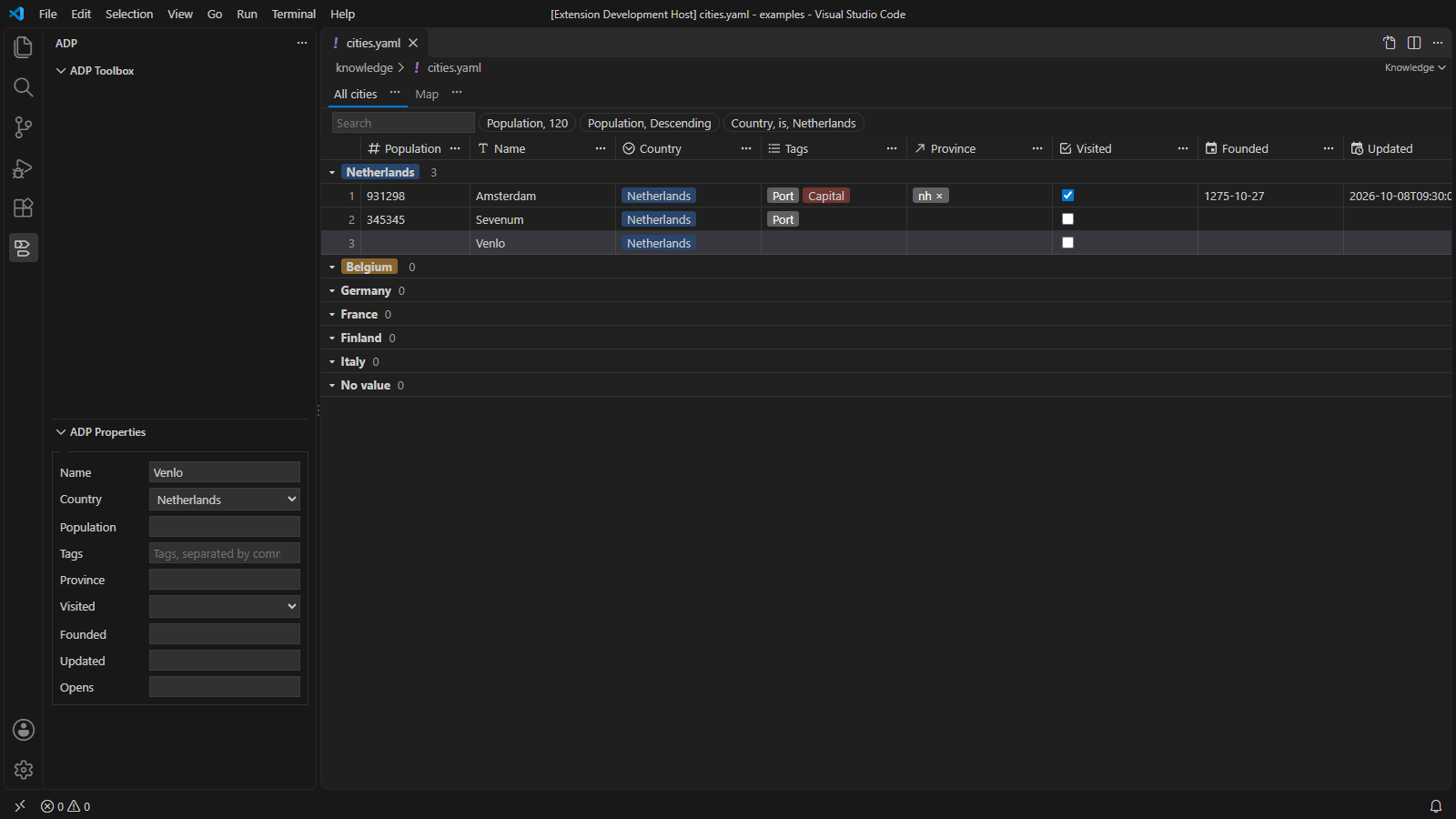
Visual Studio Code, at 683d9b0
What is visible: The Cities table in its All cities view, with the Map view's tab beside it, the sort, filter and column chips above, the rows grouped by country with Netherlands unfolded, tags and the province relation as chips; ADP Toolbox empty, since a table offers nothing to place; a cell of one row selected, with that row's fields in ADP Properties. A table has no drawing to centre.
Why it matters: A table of cities kept in a plain YAML file opens inside VS Code as a database view, grouped, sorted and filtered, with tags and a relation to the provinces file as chips, while every change is written back to the file.
Licence: Apache-2.0
Background
Focus areas
Sources
etalii-adp/etalii.adp.ide.standalone@9b232f0docs/tools.md, licence Apache-2.0etalii-adp/etalii.adp.ide.intellij@dc9c697docs/tools.md, licence Apache-2.0etalii-adp/etalii.adp.ide.vscode@ab93d8fdocs/tools.md, licence Apache-2.0etalii-adp/etalii.adp.ide.standalone@5ac81b3docs/screenshots/knowledge.png, licence Apache-2.0etalii-adp/etalii.adp.ide.vscode@683d9b0docs/screenshots/knowledge.png, licence Apache-2.0- Notion, edited (page
3f3be2fd-05b6-8108-82f0-d9d19c187013), licence Apache-2.0

