

SPARQL query
Read a SPARQL query as the graph pattern it matches, with variables as joins.
Diagram · origin tag w3c/sparql · Database queries & results
Availability
| Host | State | How to get it |
|---|---|---|
| Standalone | Available | Install from v0.1.3826-alpha |
| Desktop | Not yet released | Not yet released |
| IntelliJ Platform | Not planned | Not planned |
| Visual Studio Code | Not planned | Not planned |
| Eclipse | Not planned | Not planned |
| ThinkRail | Not planned | Not planned |
| Notion | Not planned | Not planned |
| Claude | Not planned | Not planned |
What it is for
SPARQL query (`.rq`: the basic graph pattern as a node/edge structure with variables as joins, groups as regions, filters and solution modifiers as annotation and frame; read-only). Deliberately a sibling of the `rdf-diagram` family rather than part of it — a query visualizes asking, not modeling, which is this section's whole distinction · `sparql-diagram` (specification removed from the tree; in history before `53f68611`)
Why a specialized view helps
A basic graph pattern is a shape; drawing it shows at once how variables join and which filters narrow the result.
File formats
| Extension | Format | Reads | Writes |
|---|---|---|---|
.rq | .rq | Yes | Yes |
Screenshots
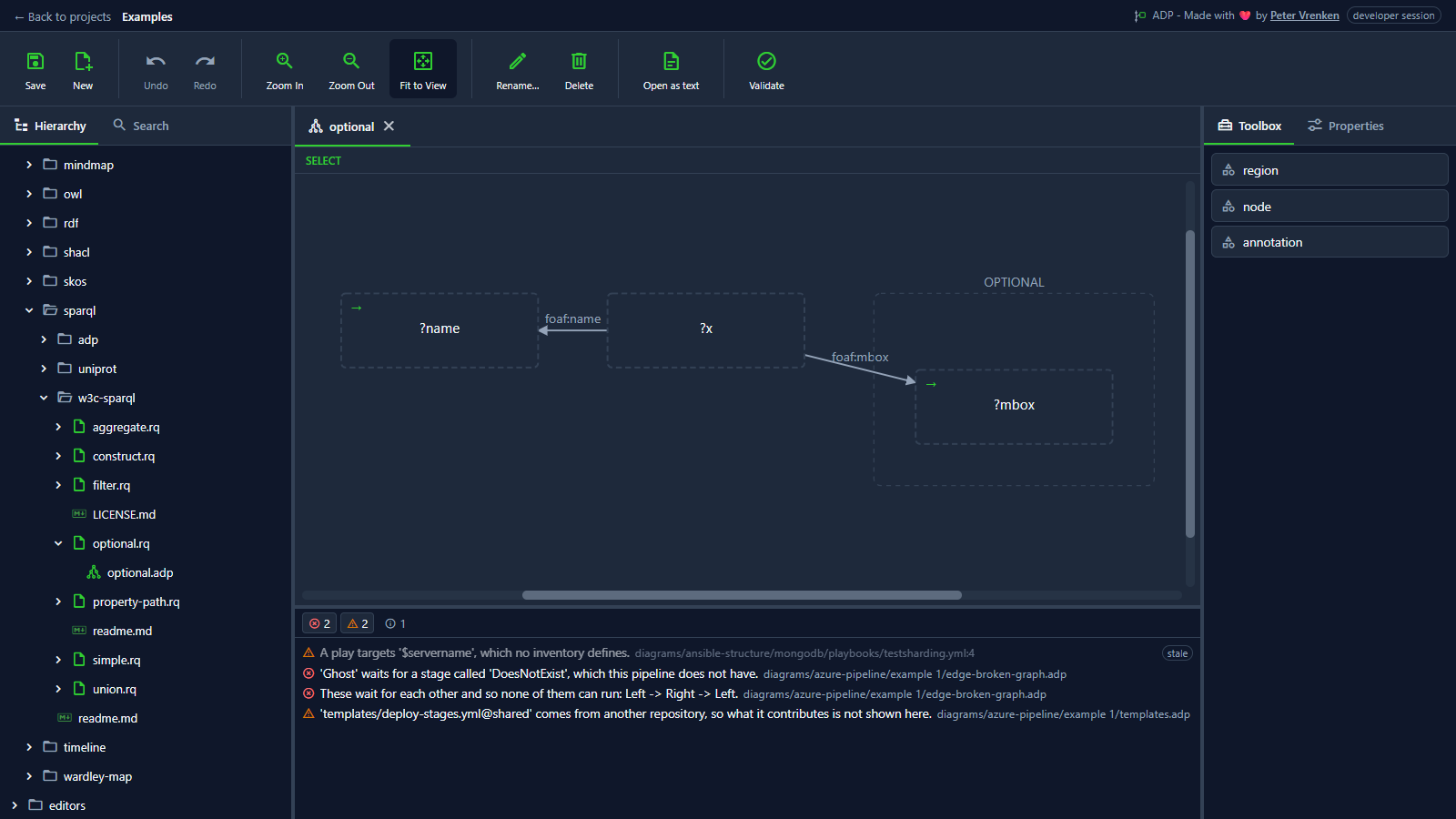
Standalone, at 3e2df46
What is visible: The `SELECT` frame, the `?x` pattern with its `foaf:name` edge, and the `OPTIONAL` group as a region holding `?mbox`. Nothing selected.
Why it matters: The query's pattern is drawn as the graph it matches, with the OPTIONAL group as a region, so which variables join and which parts are optional is visible before the query runs.
Licence: Apache-2.0
Background
Focus areas
Sources
etalii-adp/etalii.adp.ide.standalone@9b232f0docs/tools.md, licence Apache-2.0etalii-adp/etalii.adp.ide.intellij@dc9c697docs/tools.md, licence Apache-2.0etalii-adp/etalii.adp.ide.vscode@ab93d8fdocs/tools.md, licence Apache-2.0etalii-adp/etalii.adp.ide.standalone@3e2df46docs/screenshots/sparql.png, licence Apache-2.0- Notion, edited (page
3e7be2fd-05b6-8117-b918-e1d27aa08742), licence Apache-2.0
